
E.M. Carter on ‘The Flowers of Bay C’
Our author E.M. Carter answers some questions about her latest novel, The Flowers of Bay C.
What inspired you to change genres? And where did your ideas for this novel come from?
I actually wrote this one a few years ago and had the idea for it years before that - it’s been bubbling away for a long time! In fact, its themes are similar to those in my dystopian trilogy - value and worth, and what it means to be human, as well as touches of faith and hope. So the two kind of grew together in my mind. The idea for this novel was born one day while I was in hospital for quite a while with double pneumonia, and I got to know some of the ladies on my ward quite well, despite us all being very different. I got to thinking about what this could look like in a novel about six women who come together in adversity and begin to share deeply of themselves - and be changed for the good. It’s definitely rooted in my own experience of hospitals - I’m a frequent flyer, as it were - and my life with chronic illness. I wanted to represent illness and disability in fiction and bring empathy and compassion to situations people often feel are forgotten.
In dystopian fiction, there is room for a lot of creativity and a certain amount of world building because you are writing about the future. However, this book was set in the present. Did you find having to work within believable boundaries restrictive, or was it easier to work with things you knew and understood?
That’s a great question! I have loved writing dystopian fiction precisely because I could let my mind wander and come up with all sorts of situations. Not being bound by ‘reality’ is great for creativity - it’s why fantasy, for example, is such a popular genre for both readers and writers! Yet I loved writing Flowers just as much, just in a different way. I had to stick within the boundaries of what a hospital setting is like, what happens there, even right down to what colour uniforms different nurses wear and the ranks of doctors and what that means. Luckily (or not, in fact!) I have a lot of experience of hospitals as a patient, so I was able to draw on that to craft the narrative and within that I found myself free to create and imagine despite the bounds (I might have somewhat pushed them in some places!)
I know your dystopian fiction, your poetry and your reflections, but this is a new genre. I really enjoyed the book - how did you find writing it?
It was actually pretty cathartic - getting out some of that stuff that can become such a burden and even part of trauma when you’re so often in hospital. But it was dreaming up the characters I loved most, because they’re all so different, and all so flawed in their own way as well - some more than others! It was also hard to write because it brought up a whole load of emotion in places as it made me face what I’d been through and perhaps never processed properly before. Being in hospital a lot has a marked effect on you because while you’re there you’re subjected to so many little things, from needles to burst canulas, which cause massive bruising, to more invasive procedures that hurt, and to things like lack of sleep due to noise as well as observations and meds at all hours. It’s a place you can’t have your own space, and you feel a little bit like an object rather than a human - an object to be dealt with, but sometimes not with compassion - although, as you’ll see in the book, I do see a whole load of compassion in hospitals too.
Were any of the characters based on you or people you know?
Kind of. The main character, Penny, does have the same disease as me, though I never name it in the book because I didn’t want to go into too much technical detail and wanted to leave it wide open for people to find themselves within its lines. She’s had a lot of the same experiences in terms of living with chronic illness in a world that values the productive and the ‘useful’, and doctors who don’t always listen, and bringing up children when you are struggling with pain. Her character reflects mine in the sense of how she sometimes puts herself down because she’s always felt lesser. But, apart from that, we’re not alike - she has wildly different experiences of relationships, for example, and processes things differently. As for the other characters, they’ve probably all got a bit of me - even prickly Violet! I guess that’s the case with any author - we’re always going to write ourselves in because we can’t help but not!
Who is your favourite character?
Oh gosh, that’s a hard one! When you’ve dreamed them all up they’re all special to you. But one of the characters who pretty much wrote herself was Jodie, the thirty-ish woman who brings everyone together due to her general nosiness and extreme curiosity about everyone and everything. She’s burying deep hurt under a blustery and humorous mask, though, so she needs all the others as much as they need her. Her story is a bittersweet one - well, you’ll have to see - but I have a very soft spot for her, not least because she quickly establishes a gentle and sweet rapport with the main character’s (Penny’s) teenage son, and I love the way they bond over a slightly wicked sense of humour. She’s definitely one of a kind.
What’s next?
I have ideas for three more books in this series. They won’t all be about the same characters, though you’ll see some of them as side characters along the way, but they’ll be based in the same area and contain a lot of the same themes and vibes. I’d like to get the sea into every one, in some way, because I loved writing about the sea in Flowers - and the coast is always my favourite place to be. Watch out for Book 2 coming late 2026 (hopefully!)
Finally, here are a few reviews from some wonderful authors:
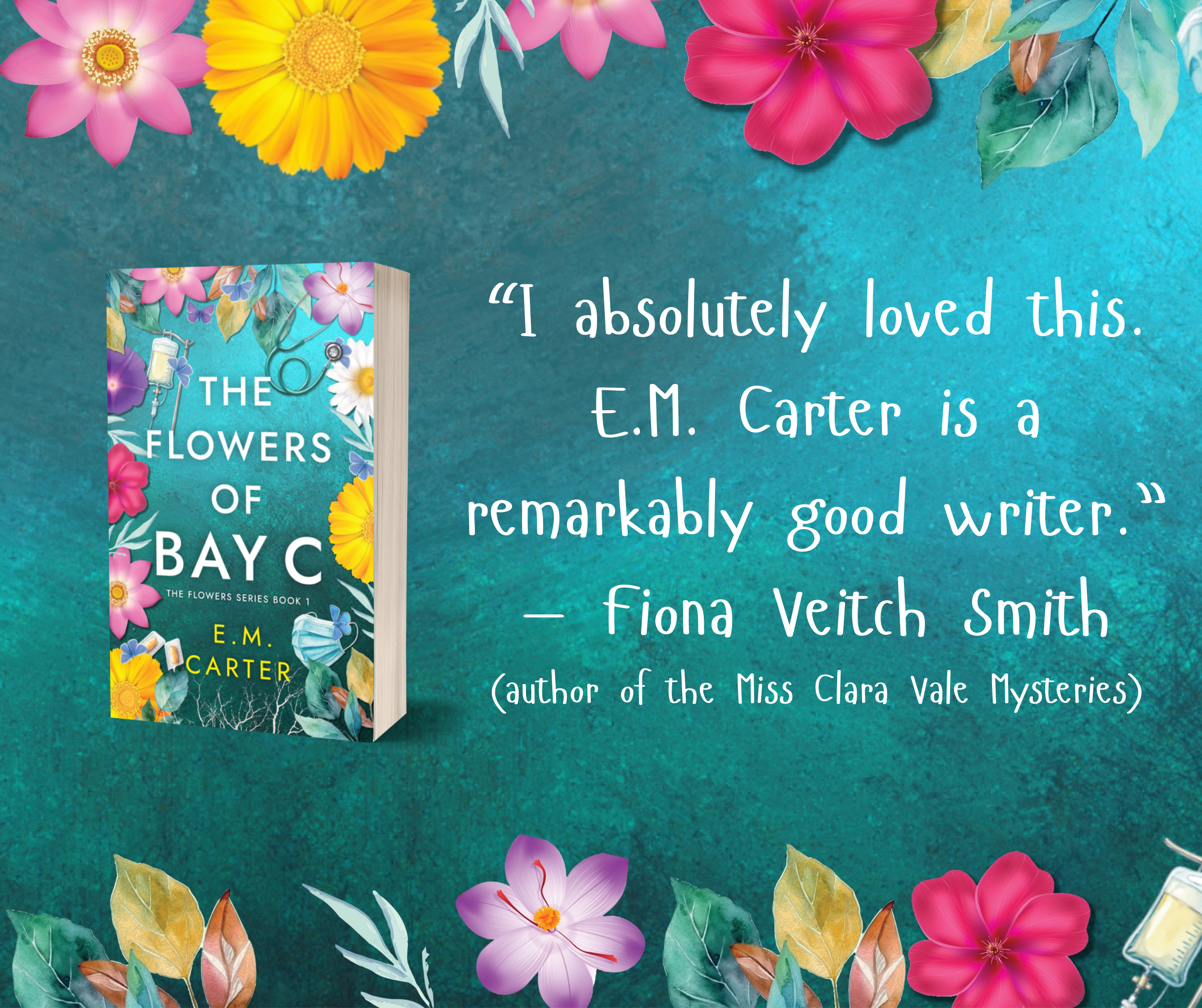
“'I absolutely loved this. E.M. Carter is a remarkably good writer.” — Fiona Veitch Smith
“Gripping, moving, funny and authentic… I couldn’t put it down.” — Ruth Leigh
“Strong, hopeful, wise… a tribute to six women’s resilience.” — S.L. Russell
“Powerful, moving, poignant.” — S.C. Skillman
“Full of heart and hope… beautifully written.” — Deborah Jenkins
“A page-turner that goes straight to the heart.” — Clare O’Driscoll
“Heartbreaking and heartwarming… a magnificent book.” — Joy Margetts